Use timed practice for
- Checking whether you can finish each part under pressure.
- Testing correspondence, diagrams, information, and viewpoints separately.
- Identifying which part slows you down most.
 CEL PIPCELPIP Practice
celpip reading practice test
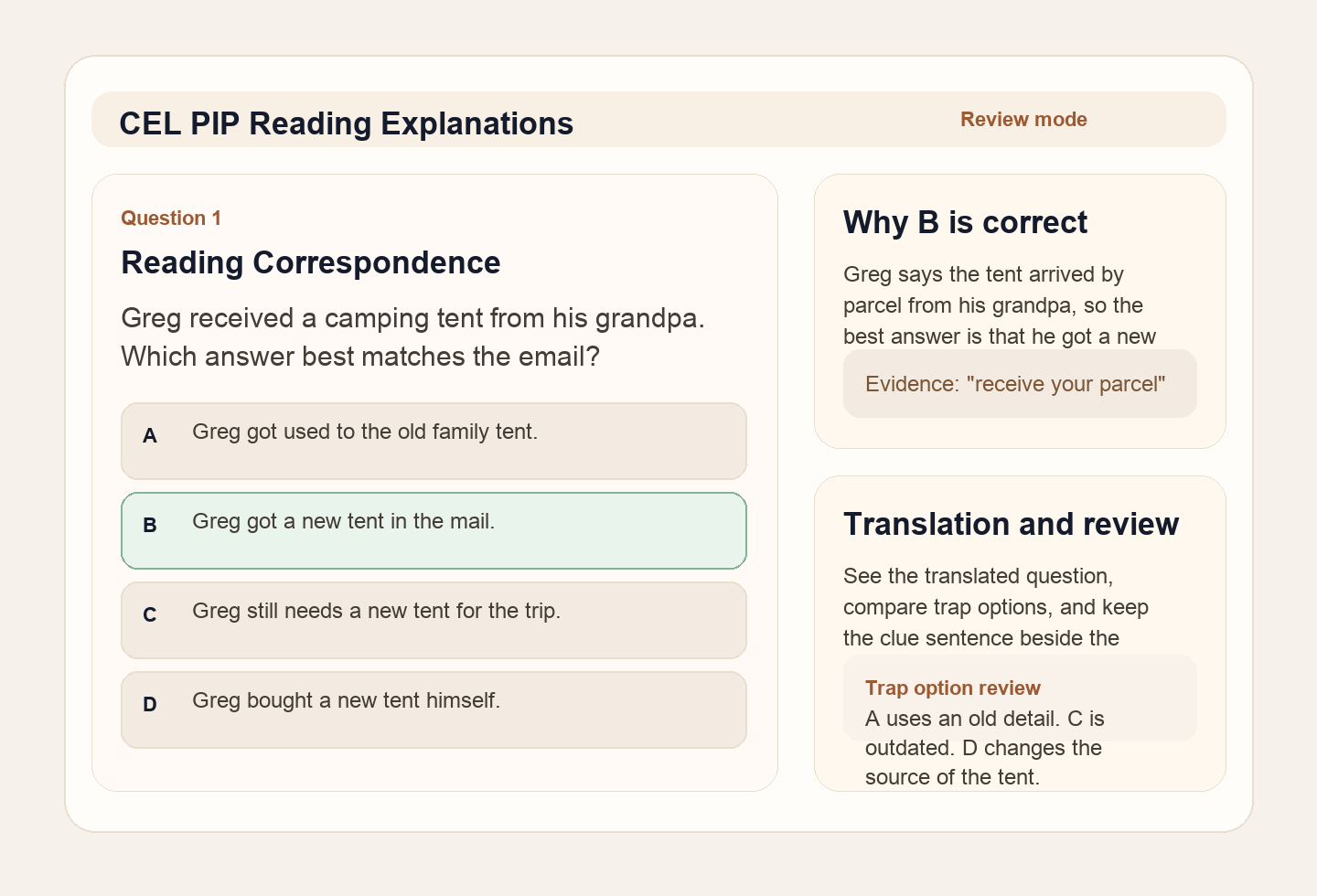
CELPIP reading improvement comes from timed attempts plus evidence review. The goal is to see which sentence proves the answer, why a near match fails, and which reading habit should change next.
Quick answer
Short answer: Use a CELPIP reading practice test under timing, then review the exact passage evidence for every miss or guess. The score is useful only when it shows which part, clue type, or trap-option habit needs to change next.
Reading mistakes usually come from rushing, matching familiar words, or missing a condition in the passage. A good practice loop forces you to prove the correct answer and explain why the wrong option looked attractive.
Practice table
| Problem | Practice mode | Review focus | Next page |
|---|---|---|---|
| Near-match traps | Part-by-part reading | Why the wrong option fails | Reading explanations |
| Slow passage scanning | Timed part practice | Where evidence appears in the passage | Multiple choice strategy |
| Full-section fatigue | Full reading section | Time use and confidence marks | Mock test |
Part breakdown
CELPIP reading is not one single skill. Different parts ask for different habits: correspondence tracking, diagram logic, detail scanning, or viewpoint comparison. The faster way to improve is to identify which part generates the same wrong-answer pattern.
These parts punish loose reference tracking. Review who said what, when the condition changed, and which detail belonged to which sender.
These parts often look easy but leak points when users skim labels and match words instead of checking relationships or conditions.
When two opinions sound similar, the real task is to separate positions, not collect individual words. Explanation review should show why one option fits the author better.
If accuracy is acceptable early and collapses late, stop doing only short drills. You need section-level pacing practice plus targeted explanation review.
Common score loss
Reading candidates often say they are just too slow. More often, the real issue is unproven answers, weak trap control, or poor passage navigation.
You choose the option that feels right but cannot point to the evidence. The fix is explanation review with one proof sentence per miss.
The wrong option repeats passage wording but misses the real condition. The fix is to log why the tempting answer failed.
You lose time because you keep rereading the same block. The fix is to mark where the clue type usually appears in each part, then verify with explanations.
Practical next step
Keep the first attempt honest.
Separate lucky answers from stable skill.
Find the clue and the trap.
Practice the part that caused the pattern.
What to do next
The right next action depends on whether the issue was evidence control, multiple-choice traps, broader score planning, or overall readiness.
| If the result looks like | Go here next | Why |
|---|---|---|
| You cannot explain why the answer is correct | Reading explanations | Review the evidence and the trap before opening more passages. |
| You keep falling for familiar wrong options | Multiple choice strategy | That is usually a clue-first elimination problem, not just a vocabulary problem. |
| Reading is only one weak part of the profile | Study plan calculator | Build a broader 7-day or 30-day sequence instead of repeating one skill page. |
| You need to understand the score meaning first | Reading score guide | Turn the result into a pacing, trap, or evidence diagnosis before another mock. |
FAQ
Review missed answers, guesses, and any answer you could not prove clearly.
It points to passage evidence and explains why the tempting option fails.
Use part practice for repeated weaknesses and full sections for timing or stamina.
It should show the evidence line, the correct-answer reason, and why the tempting wrong option fails.
They often stall when users repeat passages without reviewing proof, trap options, and the weakest part.
No. Raw practice accuracy is a planning signal; official CELPIP results are reported as CELPIP levels.
Next move