What to measure
- Can you keep speaker roles clear?
- Can you catch the answer cue before the audio moves on?
- Can you avoid trap options that reuse familiar words?
 CEL PIPCELPIP Practice
celpip listening practice test
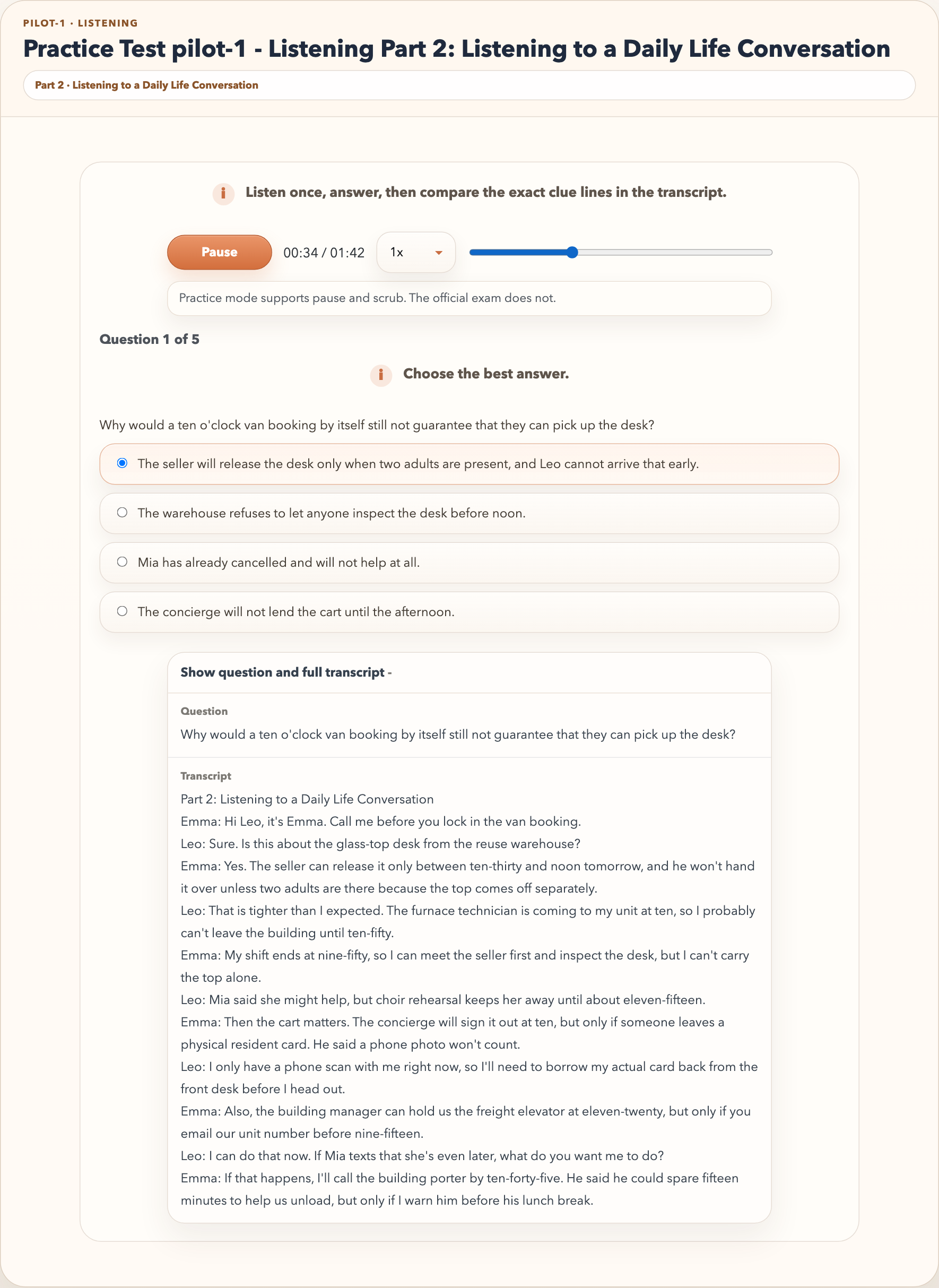
Listening practice should not become passive replay. Take one honest attempt, choose answers while the audio is still fresh, then review the transcript line that proves the answer.
Quick answer
Short answer: Use a CELPIP listening practice test by answering under timing first, then reviewing the transcript only after the attempt. The goal is to find the missed clue, trap option, and listening habit before opening another audio set.
If you open the transcript before answering, you are training reading, not listening. The stronger sequence is listen once, answer under pressure, then use the transcript to find the exact cue, contrast, number, or speaker intention you missed.
Practice table
| Problem | Practice mode | Review focus | Next page |
|---|---|---|---|
| Losing details | Short focused part | Numbers, names, times, and conditions | Transcript practice |
| Choosing familiar words | Multiple-choice drill | Trap options and paraphrase | Multiple choice strategy |
| Fatigue late in test | Full listening section | Attention control across parts | Mock test |
Part breakdown
A listening score can drop for different reasons across the section. Some users miss practical details early, others lose control once speaker intent, prediction, or shifting viewpoints appear later. Practice works faster when the drill matches that part-level failure.
Use short drills when the problem is catching names, numbers, dates, and direct conditions. These misses usually come from weak note filtering, not from needing more replay.
Use longer timed blocks when the score drops after the section gets denser. That pattern usually points to fatigue, lost speaker roles, or guessing after one clue is missed.
When the wrong option sounds familiar, the review should compare the clue sentence to the tempting answer. This is a paraphrase-control problem more than a vocabulary-count problem.
If you cannot point to the exact line that proves the answer, the timed attempt is not finished yet. Transcript review should explain the clue and the miss category before you open another set.
Common score loss
Users often assume listening is just about catching more words. In practice, the bigger issues are clue timing, trap control, and attention decay across the section.
You hear the clue, but only after the next line starts. The fix is shorter note-taking and clearer speaker-role tracking.
The wrong option repeats a familiar word from the audio. The fix is to log the contrast or condition that made that option fail.
The first half feels controlled, then guesses increase. The fix is to alternate focused-part review with full listening blocks instead of doing only one mode.
Practical next step
Answer before checking anything else.
Separate guesses from answers you could prove.
Find the sentence that made the answer correct.
Vocabulary, focus, speaker intent, number, or logic.
What to do next
Do not send every listening result into the same next action. Choose the page that matches whether the problem was clues, score meaning, overall readiness, or a broader study-plan decision.
| If the result looks like | Go here next | Why |
|---|---|---|
| You missed clue lines or speaker intent | Listening transcript practice | Review the exact clue sentence before you take another timed set. |
| You need to understand what the score means | Listening score guide | Turn the result into a pacing, clue-tracking, or transcript-review diagnosis. |
| Listening is only one part of a wider weak profile | Study plan calculator | Build a 7-day or 30-day route instead of repeating isolated drills. |
| You want a real checkpoint after review | Full mock test | Use one honest full-section run after the repeated miss stops showing up. |
FAQ
No. Answer first, then use the transcript to review the missed cue.
Write the clue sentence, the trap option, and the cause of the miss.
Take a full mock after shorter listening drills stop showing the same repeated miss.
It should preserve timed listening first, then use transcript review to identify the clue, trap option, and miss category.
No. For test-style practice, answer first under timing, then replay or read the transcript only during review.
No. Transcript review is for diagnosis after the attempt. It should support timed listening, not replace it.
Next move