First pass: treat it like the real test
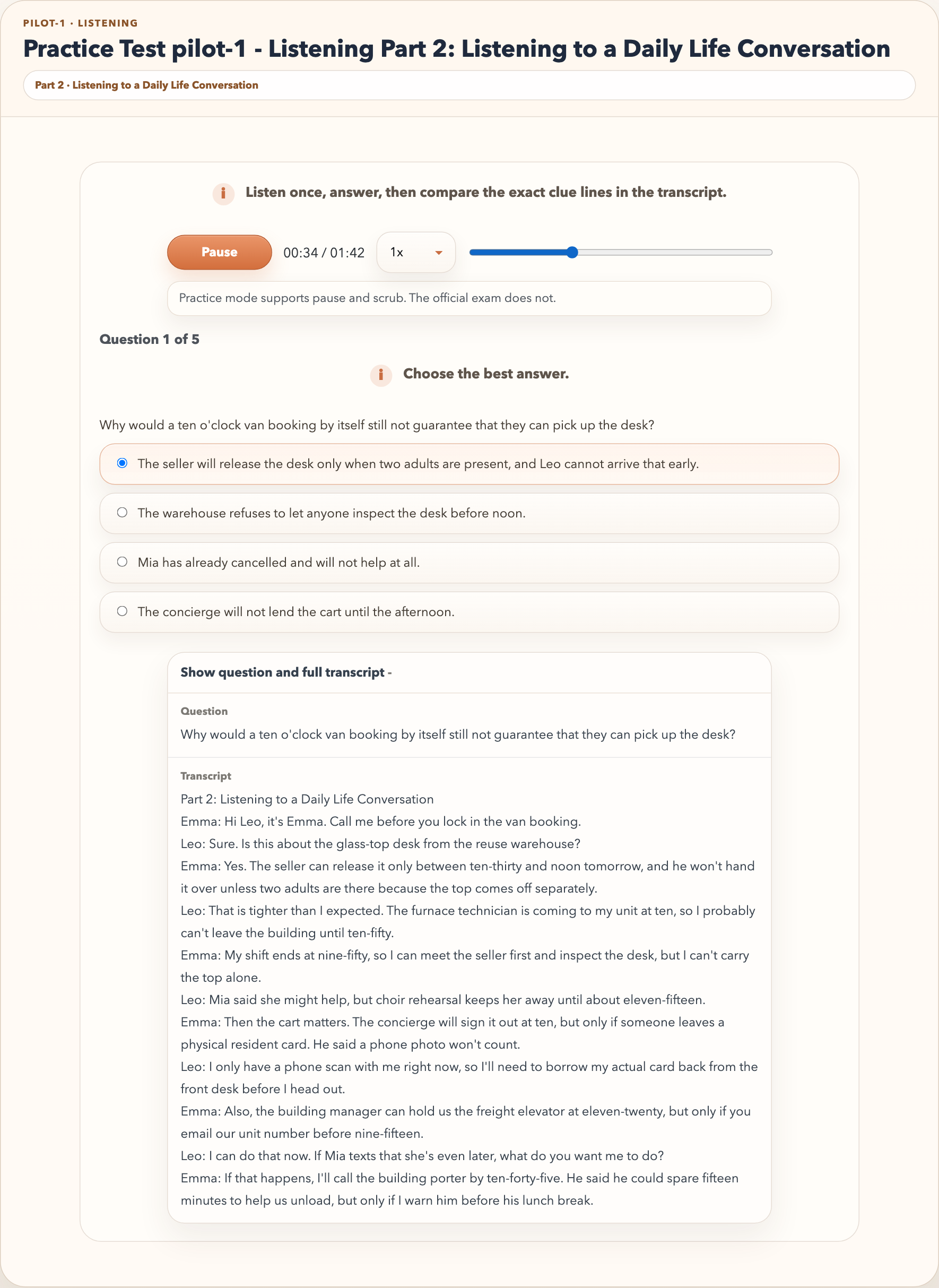
Do not open the transcript first. Play the audio once, track the speaker relationship, and answer under timing so your mistakes reflect real listening gaps.
 CEL PIP
CELPIP Practice
CEL PIP
CELPIP Practice
celpip listening transcript practice
CELPIP listening transcript practice works best after the first honest attempt. Listen once, answer under timing, then open the transcript to find the exact cue words you missed. That is how CELPIP listening practice online turns into targeted review instead of passive replay.
Quick answer
Best use: listen once, answer under timing, open the transcript, find the proof line, and record whether the miss came from vocabulary, contrast, speaker intent, or a trap detail.
Transcript practice is most useful when it explains why an answer changed. Reading the transcript first makes the task easier, but it does not train the single-play listening pressure that CELPIP candidates need.
Intensive listening
Do not open the transcript first. Play the audio once, track the speaker relationship, and answer under timing so your mistakes reflect real listening gaps.
Once you know the correct answer, use the CELPIP listening transcript to find the exact phrase you misheard, skipped, or misunderstood.
Transcript workflow
The transcript should help you prove why an answer is right, not just show that it is right. That means reading with a question in mind and marking the clue sentence that changes the answer.
“You have 5 classes left. Did you know we have a special promotion this month? If you buy a 20-class package, you get a 10% discount.”
Here the clue is not just “promotion.” The clue is the condition attached to it: buy a 20-class package. Line-by-line review teaches you to connect the offer with the actual question.
Sample flow
Follow the speakers and predict what kind of information the question will target.
Choose the best option before the memory of the dialogue fades.
Find the exact line that proves the correct answer.
Write down whether the miss came from vocabulary, focus, or logic.
Common misses
Many wrong answers come from catching one familiar word but missing the condition or contrast that follows.
Transcript review helps you see whether the speaker is asking, offering, correcting, or refusing.
Addresses, discounts, dates, and titles often push attention away from the main idea. Review shows where concentration broke.
If the question asks “what will most likely happen next,” the clue is usually an implication, not a direct quote.
FAQ
Open it after your first honest attempt. Listen once, answer under timing, and use the transcript only during review.
Mark the sentence that proves the answer, note any contrast words, and record why the wrong option felt tempting.
Yes. You can open a listening section directly and review the transcript workflow after the timed attempt.
No. Use transcript review after a timed attempt so the review explains real missed cues instead of replacing listening pressure.
It becomes useful when you connect each answer to a proof line, contrast word, speaker intention, or trap detail.
Use it after missed or guessed answers. One focused review after a single part is better than replaying many parts passively.
Start listening practice
Start with a free listening set and use transcript-based review only after the timed attempt.