Practice should reveal
- Whether the response fully answers the prompt.
- Whether tone and register match the situation.
- Whether organization stays clear under time pressure.
 CEL PIPCELPIP Practice
celpip writing practice test
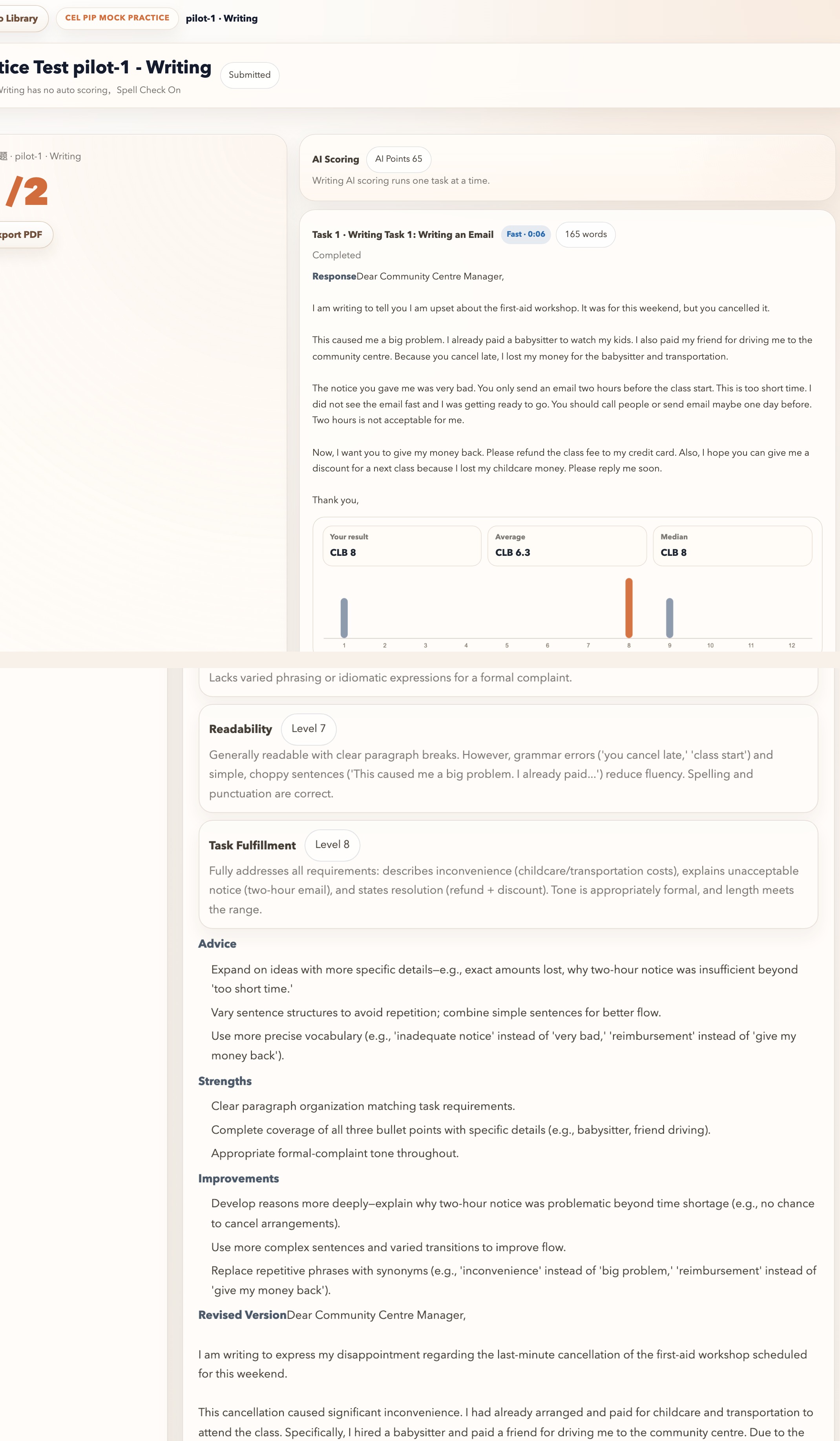
CELPIP writing practice is strongest when a timed response becomes a clear revision target. Write the task, inspect criterion feedback, compare a stronger version, and carry one correction into the next prompt.
Quick answer
Short answer: Use a CELPIP writing practice test to write Task 1 email and Task 2 survey responses under timing, then review criterion feedback. The useful result is not only a score; it is one clear revision target for the next prompt.
The common mistake is writing many tasks without learning which weakness repeats. A better loop is: write under timing, score by criterion, compare the revision, then write a new response that fixes the same issue.
Practice table
| Weakness | Practice mode | Review focus | Next page |
|---|---|---|---|
| Email tone | Task 1 email response | Purpose, politeness, and missing details | AI scoring workflow |
| Survey structure | Task 2 opinion response | Position, support, and conclusion | Writing target 9+ |
| Repeated grammar leaks | Short timed rewrite | Sentence control and readability | Common errors |
Task breakdown
Many users keep rewriting the same shape for both writing tasks. That usually hides the real weakness. Email tasks expose context fit and tone control. Survey or opinion tasks expose position control, support, and paragraph logic.
Review whether the response handled the real purpose, included the needed details, and matched the tone of the relationship. A polite but incomplete email still leaks points.
Review whether the answer takes a clear position, supports it with specific reasons, and closes cleanly. Generic ideas usually matter less than clear support and structure.
Do not revise everything at once. Pick the criterion that actually lowered the score: task completion, tone, support, organization, or language control.
After revision, test the same weakness on a new prompt. Otherwise you only learn how to polish one saved answer.
Common score loss
Grammar matters, but it is often not the first reason a writing score stalls. The bigger leaks are incomplete task response, weak support, and revisions that do not carry into the next prompt.
The response sounds fine but leaves out a required detail, audience signal, or direct answer. This is a task-fit problem before it is a language problem.
The opening is clear, but the middle stays generic. The fix is to add one stronger example or reason rather than making the draft longer everywhere.
You write another response without carrying over one correction target. The fix is to use AI feedback to choose one repeatable change for the next task.
Practical next step
Complete the task under realistic timing.
Find the score drop, not just the final number.
Look at what the stronger version changes.
Fix the same weakness in fresh context.
What to do next
Writing practice works best when the next action matches the real leak: criterion feedback, target score work, or a broader study-plan decision.
| If the result looks like | Go here next | Why |
|---|---|---|
| You need criterion-level feedback and revision examples | Writing AI scoring | Use the scoring workflow to find the real criterion leak before writing again. |
| You are aiming for a stronger 9+ style response | Writing target 9+ | Focus on cleaner task fit, support, and revision quality instead of generic longer answers. |
| Writing is only one blocker in a wider weak profile | Study plan calculator | Build a full 7-day or 30-day plan instead of repeating writing only. |
| You want score meaning before another rewrite | Writing score guide | Turn the writing result into a task-fit, tone, support, or grammar diagnosis. |
FAQ
Practice both task types, but start with the one where task completion or tone breaks down more often.
No. The score must be connected to criterion feedback and a specific revision target.
Pick one correction target, write a new response, and check whether the weakness appears again.
No. AI writing scoring is independent practice feedback, not an official CELPIP score.
It should include a timed draft, a purpose and tone check, criterion feedback, and one revised version.
It should include a clear position, specific support, paragraph control, and a review step for focus.
Next move