What to focus on
- Topic-based vocabulary that repeats across everyday Canadian situations.
- Synonym replacements you can produce under time pressure.
- Short review loops that are easy to repeat every day.
 CEL PIP
CELPIP Practice
CEL PIP
CELPIP Practice
celpip vocabulary practice
CELPIP vocabulary practice works better when words stay attached to real situations like housing, work, healthcare, customer service, and daily problem-solving. Instead of memorizing disconnected lists, study vocabulary by topic, add synonym replacement, and review in short sets you can still reuse in writing and speaking.
Quick answer
If you only want the shortest useful recommendation, do not start with a huge random word list. Start with common CELPIP situations such as housing, work, healthcare, and customer service. Then review small sets, and turn weak words into better paraphrases you can actually reuse in writing and speaking under time pressure.
Best use: study one everyday topic, replace weak words with practical synonyms, then say or write a short timed example so the vocabulary becomes usable.
Scenario vocabulary
The exam repeatedly uses everyday Canadian settings: renting, customer service, healthcare, travel, work, and community life. A topic-based list helps you build phrases you can actually use in speaking and writing.
Synonym replacement
Repeating the same basic word makes both writing and speaking sound flat. Synonym practice helps you switch quickly to a cleaner phrase when the first word that comes to mind is too weak.
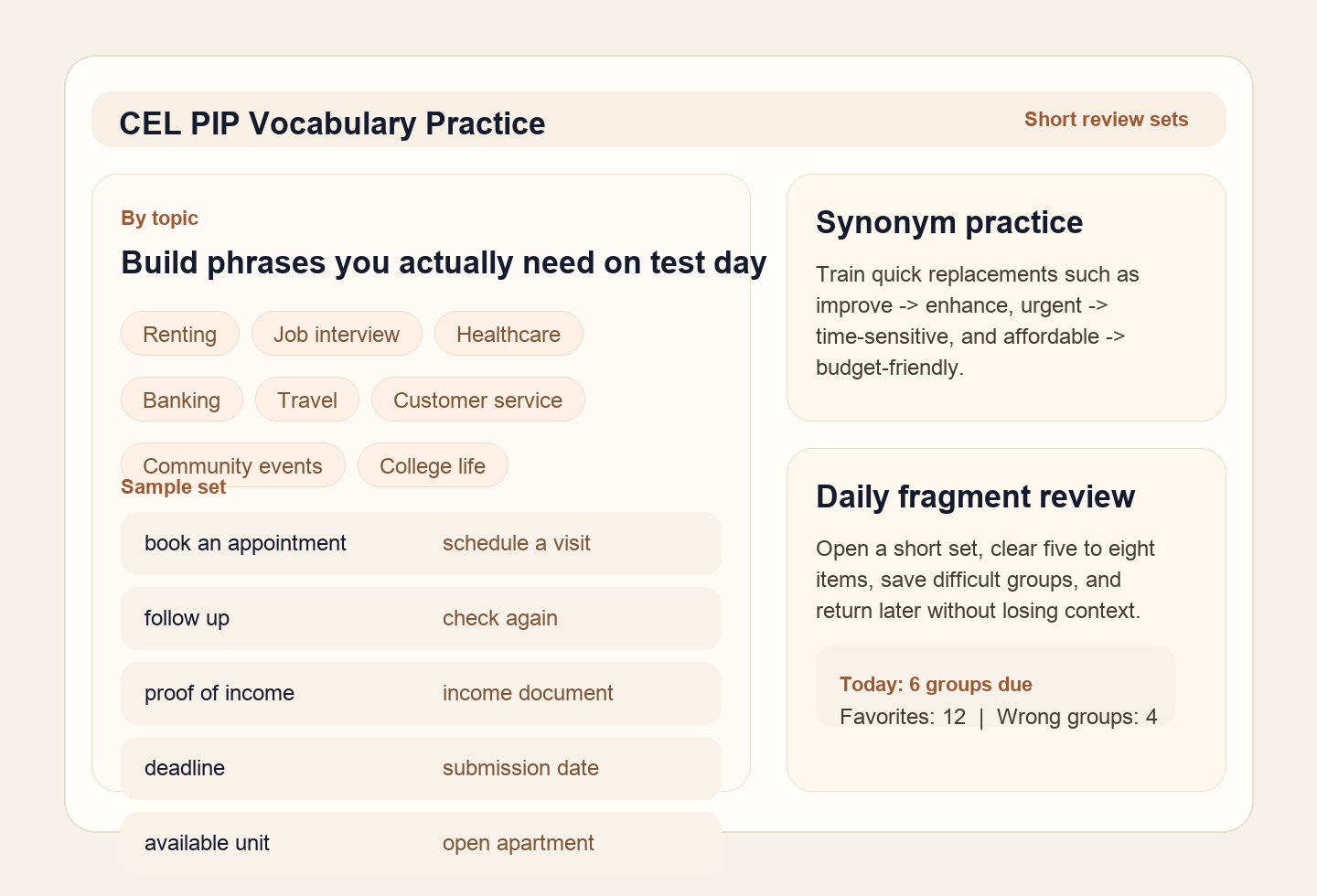
Focus on replacements you can actually use under pressure: improve → enhance, urgent → time-sensitive, cheap → affordable, helpful → supportive.
| Mode | Best for | How to use it |
|---|---|---|
| Topic vocabulary | Building practical word groups for common CELPIP situations | Study one scene at a time and say or write a few short examples immediately. |
| Synonym review | Reducing repetition in speaking and writing | Replace one weak word family with two or three stronger alternatives you can actually remember. |
| Short daily review | Retention without burnout | Review a small saved set every day instead of waiting for one large catch-up session. |
Fragmented practice
Clear one small group before work, after class, or between mock sections. Short sets are easier to repeat consistently.
Flag weak synonym groups and return later. Repeated exposure matters more than one long study session.
Screenshot and sample list
These are the kinds of replacements worth reviewing before writing and speaking tasks.
FAQ
Start by topic. CELPIP repeatedly uses everyday situations such as housing, work, healthcare, and customer service, so grouped vocabulary is easier to reuse.
Synonym practice helps you avoid repeating basic words and improves paraphrase recognition in both reading and writing.
Yes. Short daily review sets are easier to repeat consistently and fit better beside full mock exam practice.
Start with everyday topics such as housing, work, healthcare, customer service, travel, school, and community situations.
No. Useful, reusable words and phrases are safer than rare vocabulary that you cannot produce naturally under timing.
Write or say one short example immediately after learning a word, then reuse it in a timed writing or speaking task.
Start vocabulary practice
Use scene-based sets for situational vocabulary, or open synonym review when you want faster paraphrase training.