celpip clb score guide

Read CELPIP scores in the same language your Canada plan uses

Candidates usually search CLB when they are no longer asking what the test is. They are asking what threshold matters, which section is blocking them, and how to read an official score chart without mixing it up with program-specific minimums.

  • Current official equivalencies
  • Shareable chart image
  • Section-first planning

Updated on April 11, 2026 using the current CELPIP score chart and current IRCC program tables.

Official score table

Use the raw equivalency chart first, then apply your program threshold

The official CELPIP score chart and IRCC program pages answer slightly different questions. The CELPIP chart tells you the reporting equivalency. IRCC pages tell you which minimum section scores matter for a specific immigration or citizenship pathway.

Reading tip: CELPIP's December 6, 2023 score-report update replaced the old M range with 0-2. Some official guidebook snapshots still show legacy formatting, so this page notes the current reporting update and the older score-user wording side by side.
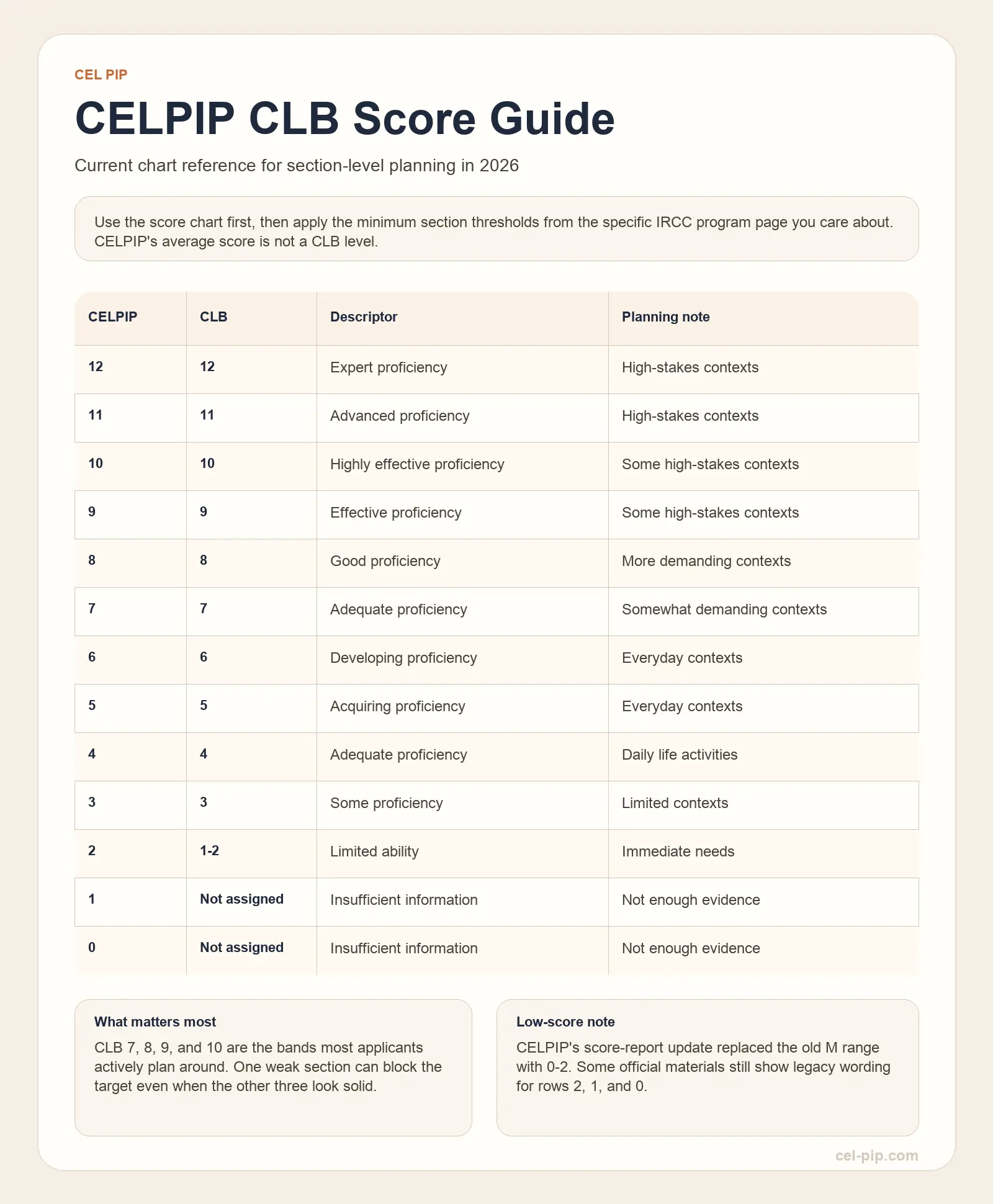
Current CELPIP-to-CLB score guide using the official CELPIP score chart and score-report update notes.
CELPIP level CLB equivalent Official descriptor Planning note
12 12 Expert proficiency in high-stakes contexts Useful for a score report, but most IRCC targets stop below this band.
11 11 Advanced proficiency in high-stakes contexts Still above the thresholds most candidates need for immigration planning.
10 10 Highly effective proficiency in some high-stakes contexts CLB 10 is where many strong score targets stop feeling abstract and start feeling strategic.
9 9 Effective proficiency in some high-stakes contexts CLB 9 is a common section-level milestone in Express Entry planning conversations.
8 8 Good proficiency in more demanding contexts Often the difference between “solid English” and “score-efficient English” on a profile.
7 7 Adequate proficiency in somewhat demanding contexts CLB 7 is a frequent eligibility floor, so one weak section here matters immediately.
6 6 Developing proficiency in everyday social, educational, or workplace contexts Good enough to show skill growth, but still below many competitive profile targets.
5 5 Acquiring proficiency in everyday contexts Relevant for some program thresholds, especially when the minimum floor is CLB 5.
4 4 Adequate proficiency for daily life activities CLB 4 is a floor in some IRCC streams, but it is not a comfortable margin.
3 3 Some proficiency in limited contexts Below the thresholds most CELPIP applicants are aiming for.
2 1-2 Limited ability in contexts related to immediate needs Older score-user tables separate this row; the newer score-report update groups very low results into 0-2 reporting.
1 Not assigned Insufficient information to assess Not useful for CLB planning and not relevant for typical IRCC minimums.
0 Not assigned Insufficient information to assess Not useful for CLB planning and shown only for score-report completeness.

What IRCC usually publishes

Program pages usually publish section minimums from CLB 4 upward, not the full 0-12 score chart.

What CELPIP publishes

CELPIP publishes the full reporting chart and separately reminds score users that the average score is not a CLB level.

Shareable chart

Use the image version when you need a fast visual reference or a forum-safe asset

This chart is built for sharing in Reddit posts, small-group chats, and community notes without losing the numeric mapping. The PNG is cleaner for reposting. The WebP is lighter for page performance.

CELPIP CLB 分数对照表 2026最新版 - CELPIP官方等效分数
Light watermark, full score rows, and no overlay on the number columns. Use the PNG for reposting and the WebP for lighter on-page display.

Target bands

Think in section bottlenecks, not just one headline result

Listening

If listening lags, your CLB plan usually fails because one missed clue sentence cascades into multiple lost items.

Reading

Reading often drops below target because of pace and trap-option review habits, not because the passage is unreadable.

Writing

Writing targets should be read alongside criterion-level issues. A score table cannot tell you whether the real problem is structure, task completion, or weak language control.

Speaking

Speaking plans fail when fluency style hides incomplete answers. A clean CLB target still needs full task completion and timing control.

How to use it

Use the chart to plan the next study move, not just to admire the number

Read the target, then inspect the weak skill

The chart tells you where you need to land. Your practice data tells you why you are not there yet.

  • Check the target section by section.
  • Ignore the temptation to average the four skills mentally.
  • Fix the lowest section before chasing a heroic full retake.

Do not confuse the average score with CLB

CELPIP's current FAQ is explicit: the average score does not map to a CLB level and is not used by IRCC for immigration or citizenship decisions.

  • Use section scores for planning.
  • Use program pages for minimum thresholds.
  • Use the full CELPIP chart for score-report interpretation.

FAQ

Questions this guide should answer cleanly

Why do candidates search for CLB instead of raw CELPIP scores?

Because CLB is the planning language used in immigration conversations, while CELPIP is the score-report format that produces the section results.

Should I plan by overall score or by section score?

Plan by section score first. A single weak skill can block the target even when the other sections look comfortable.

Does the CELPIP average score map to a CLB level?

No. CELPIP states that the average score is not equivalent to any CLB level and is not relevant for IRCC purposes.

Use real attempts

Compare your practice results against the target instead of guessing from memory

The fastest way to make a CLB table useful is to pair it with timed attempts from a real-feeling test interface.